Forward Deployed AI Engineer
Define real problems on the industrial floor, and turn the solutions into SECA's core product.
- Internship · full-time
- Seoul (Seocho) · NAVER D2SF Gangnam
- Flexible hours
About SECA
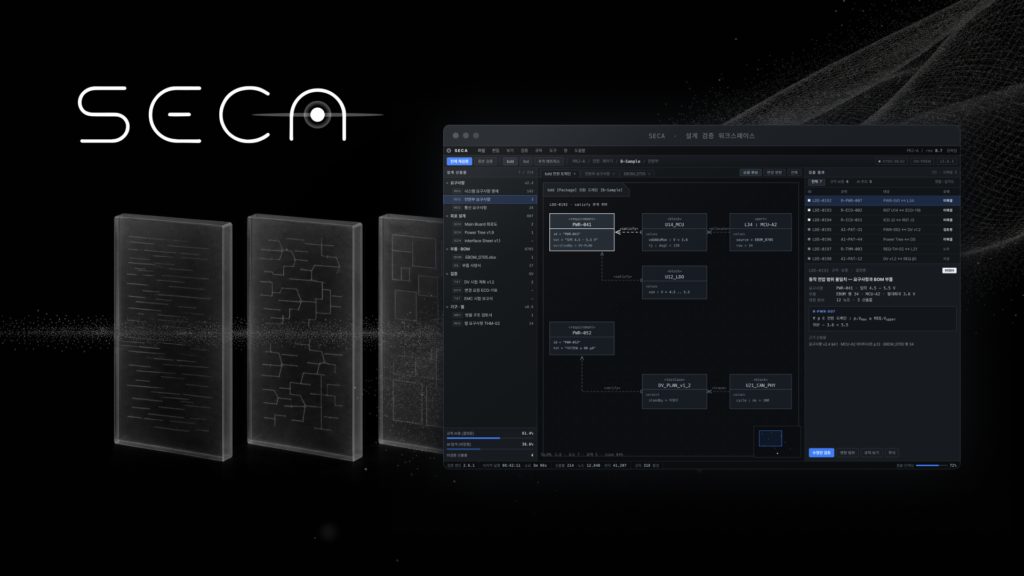
SECA is a deep-tech startup spun off from LG Electronics' in-house venture program. Working from real hardware design data from the industrial field, we build AI agents that cut engineers' design lead time. The co-founders and core researchers are AI researchers with bachelor's and master's degrees from Seoul National University, KAIST, Yonsei University and Korea University.
We run proof-of-concept projects with the actual design organizations of major manufacturers in Korea and abroad, researching and productizing ontology, knowledge graphs, AI agents, multimodal document intelligence and LLM evaluation.
- Working with
- LG Electronics (vehicle and home-appliance divisions), Hyundai Motor, DB GlobalChip, BOS Semiconductors, KEPCO, HL Robotics
- Compute
- Backed by NVIDIA Inception and the AWS Global Startup program — GPUs and a wide range of models are yours to experiment with.
- Global
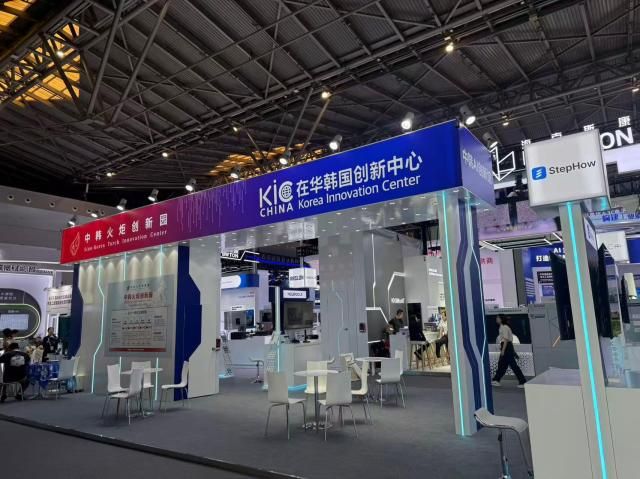
- We exhibit regularly at industrial and AI shows in Korea and abroad, and are preparing to expand into Vietnam, China, Europe and Austin, Texas.
What you will do
Whichever track you join, you solve real customer problems — starting in the field and ending in the product.
01
Manufacturing AI projects
- Work alongside the actual design organizations of major manufacturers in Korea and abroad.
- Listen to the problems working engineers face and structure them into problems AI can solve.
- Own one problem within a project end to end: data analysis, model and pipeline design, experiments, evaluation and improvement.
- Abstract the problems that recur across customer projects and grow them into SECA's shared modules and product.
02
AI research
- Go beyond reading papers — validate performance on real industrial data.
- Pursue EDA × AI research, including joint work with university labs aimed at DAC, ICCAD, MLCAD, ISEDA, TCAD and top-tier AI venues.
03
AI product engineering
- Implement evidence linking, structured output, verification logic and evaluation pipelines so model output can be used in real design work.
- Turn features proven in customer projects into product modules instead of leaving them as one-off code.
Who we are looking for
- You design the architecture and data flow yourself rather than piling up code by leaning on AI.
- You can read a paper or a new method, implement it quickly and run comparative experiments.
- You do not ship AI-generated code as is — you verify that its structure and quality fit the problem, and raise the bar yourself.
- You quickly make sense of an unfamiliar industry and its documents, and structure the problem.
- When results do not come, you dig into the cause instead of switching to a new framework.
Nice to have
- Deploying and operating an AI service in a real customer environment
- Deployment with Docker, Kubernetes, AWS/EKS or on-premises environments
Tracks
Ontology · Knowledge Graph · RAG
Structure scattered design knowledge into an ontology and knowledge graph, and build RAG on top of it that retrieves the right evidence.
What you do in this track
- Design the ontology and knowledge-graph schema that relates requirements, parts and design blocks.
- Implement retrieval, reranking and Graph RAG pipelines over structured design data — and decide where semantic search, attribute filters and numeric or range conditions belong.
- Link source evidence to every answer and proposal, and build evaluation sets and pipelines that measure retrieval and generation quality separately.
- Trace why retrieval fails on customer data, and turn recurring processing into shared schemas and modules.
Strengths that fit
- You have designed an ontology or knowledge graph yourself and populated it with real data.
- You took RAG past the demo: set metrics and pushed retrieval and reranking quality up.
- When a result is wrong, you can tell whether the cause is the data, the indexing, the query or the generation.
Nice to have
- Hands-on Graph RAG implementation
- Building datasets or LLM evaluation benchmarks
- Fine-tuning embedding or reranker models
Multimodal Document Parsing
Turn engineering documents made for human eyes — datasheets, drawings, schematics, tables — into data AI can understand.
What you do in this track
- Extract and structure text, tables, shapes and symbols from requirements, datasheets, drawings, schematics and BOMs.
- Parse documents where layout is meaning — tables, diagrams, schematics — by combining VLMs, OCR and layout analysis.
- Keep the unit, condition and source location with every extracted value so retrieval and verification can cite it later.
- Build evaluation sets from failure cases per document type, and compare before and after every model or pipeline change.
Strengths that fit
- You have gone deep on multimodal document, table or diagram understanding with real documents.
- You have analyzed error patterns in OCR and VLM output and raised quality with post-processing and verification logic.
- You have stuck with messy inputs — scans, multi-level tables, drawings — until they were handled.
Nice to have
- Model fine-tuning and inference optimization
- Building datasets or benchmarks for document AI
- Processing engineering documents such as CAD drawings or schematics
Design Automation Agent
Read and understand circuits and block diagrams, then design the agent flows that automate an engineer's design work.
What you do in this track
- Read schematics, block diagrams, RTL and BOMs, break an engineer's design and review work into steps, and turn them into agent flows.
- Implement agents that draft a block diagram and candidate parts from requirements, and find design errors and omissions with evidence.
- Compose tool calls, structured output and verification logic into multiple stages — built so a failure at any stage can be reproduced and analyzed.
- Talk directly with working engineers to decide what gets automated and where a person must check.
Strengths that fit
- You can read a circuit or block diagram and understand the design intent.
- You have automated a real workflow with LLM agents, multi-agent systems or MCP.
- When an agent produces a plausible wrong answer, you can design the verification step that catches it.
Nice to have
- Industry or research experience in circuits, semiconductors, EDA or manufacturing
- EDA × AI research (DAC, ICCAD, MLCAD and similar)
- RTL and verification (assertions, testbenches)
Terms
- Employment
- Internship or full-time (part-time during the semester is negotiable for interns)
- Location
- Seoul (Seocho) · NAVER D2SF Gangnam
- Hours
- Flexible hours
- Openings
- A few positions
- Compensation
- Negotiated based on experience and skills
- Tooling
- Latest AI coding tools (Claude Code, Codex) and GPU servers provided
Hiring process
01
Application review
02
Coffee chat
03
Project & tech interview
The one-week project is a small, real problem you solve yourself.
We look less at the right answer than at how you understand the problem, form hypotheses, experiment and verify the results.
How to apply
- info@secalabs.com
- Email subject
- [SECA Application] Your name
- Résumé
- A description of one flagship project you contributed to directly, or a paper you wrote — show us the single problem you dug into most deeply.
- GitHub or LinkedIn link
More than what you built, we want to see what the problem was, what failed, how you found the cause, and what you actually improved.